Liverpool-Belfast Green Shipping Corridor
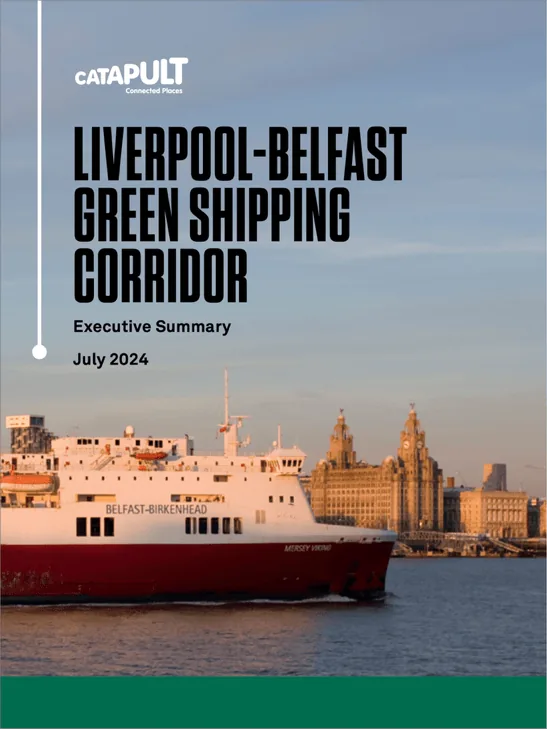 The Irish Sea is a critical artery for transport and logistics and the “blue economy”, encompassing ports, air, road, and rail networks. A key strategic project for the Connected Places Catapult is the creation of a Green Shipping Corridor between Liverpool and Belfast with the aim of decarbonising one of the busiest routes in the Irish Sea[37]. This initiative aligns with global efforts like the Clydebank Declaration, which seeks to establish zero-emission maritime routes. The maritime sector in this region is a significant economic driver, supporting approximately 46,000 jobs and contributing £5.6 billion annually in the Liverpool region, while in Northern Ireland, it supports around 16,000 jobs and adds £3.9 billion to the UK economy. This corridor will primarily serve two operators - Stena Line for passenger and RoRo services, and BG Freight for container services4. Currently, a single Stena Line sailing produces about 70 tonnes of CO₂, while a BG Freight sailing produces 25 tonnes of CO₂. The project's goal is to eliminate these emissions through a collaborative, end-to-end approach involving the entire value chain.
Two key areas for decarbonisation have been identified and prioritised:
- AT BERTH (HOTELLING DEMAND): The preferred solution is providing onshore power supply (shore power) to eliminate the need for vessels to run their diesel generators while docked.
- AT SEA (PROPULSION DEMAND): For the 130-nautical-mile journey, low-carbon liquid fuels are considered the only currently viable option. E-Methanol is identified as the industry-preferred alternative fuel. However, it presents challenges, as it has a lower energy density and requires approximately 2.3 times the fuel volume compared with marine diesel.
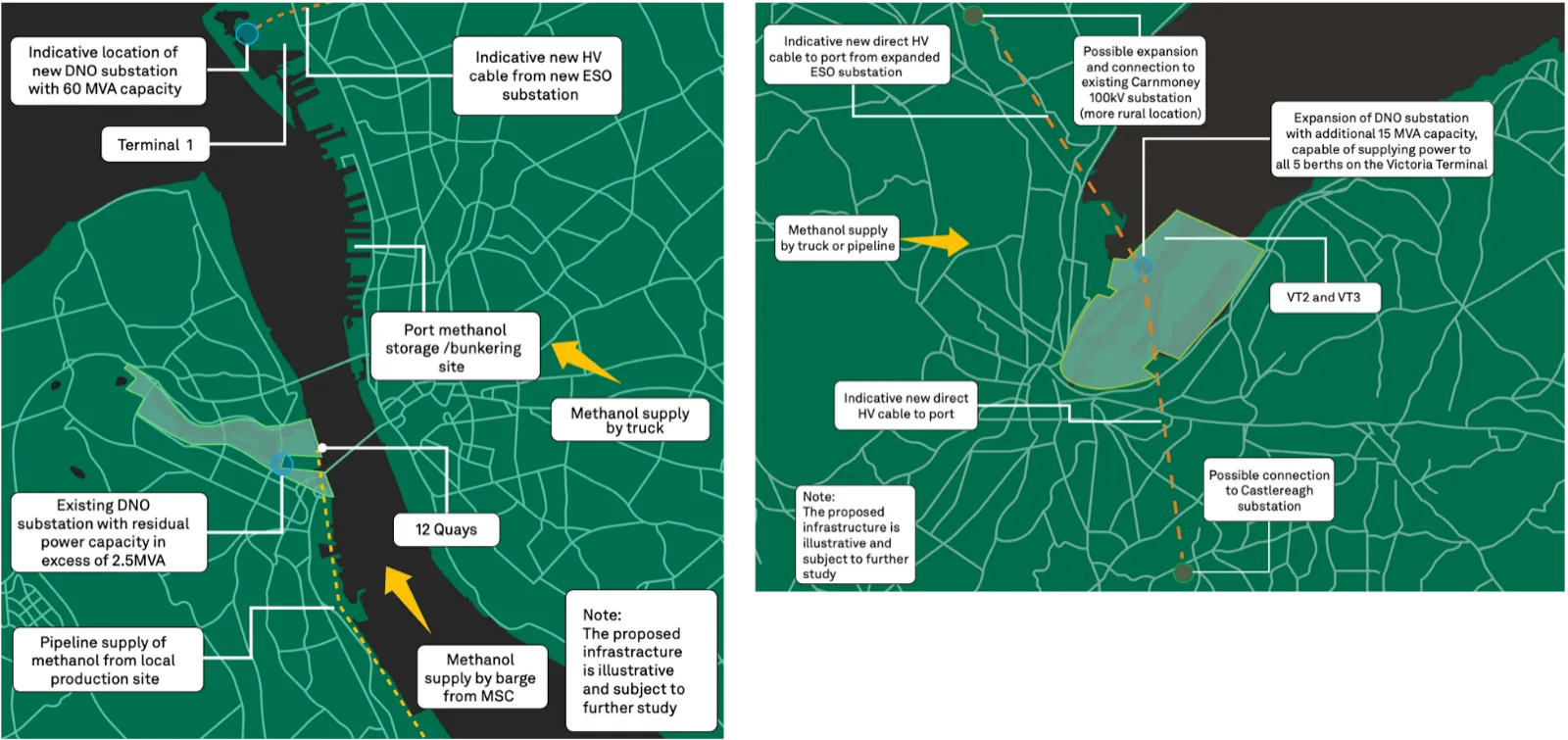
This will necessitate significant infrastructure investment and changes at both ports. Both Liverpool and Belfast will need major upgrades to their electrical grids, including the potential construction of new high-voltage substations and cabling to handle the increased energy demand of shore power. Infrastructure must be adapted to safely store and supply alternative fuels such as e-methanol. For Liverpool, supply could come from nearby facilities like Stanlow 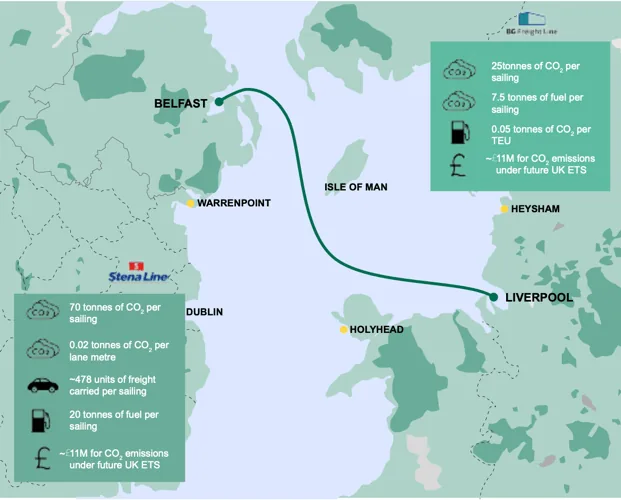 Terminal or Hynet, while Belfast could be supplied by innovators in the region, including a potential production site at the Port of Larne. Collaboration between government, port operators, shipping lines, and energy providers is crucial for success. The primary barriers identified are the high cost and risk of innovation, highlighting the need for external investment until alternative fuel supply chains mature across the UK and Europe. The focus is on four high-priority initial projects to accelerate development of the green shipping corridor:
- INCENTIVISED SHORE POWER COMMERCIAL MODEL: Designing an attractive commercial model (to encourage private investment in shore power infrastructure.
 SINGLE BERTH SHORE POWER IMPLEMENTATION: Installing a shore power connection for a single Stena Line berth in either Liverpool or Belfast to test feasibility and learn from the process before scaling up.
- IRISH SEA ENERGY SIMULATION MODEL: Developing future forecast energy demand models and evaluating economic feasibility of different electricity and alternative fuel supply chain options to guide investment.
- E-METHANOL TRIAL PRODUCTION: Launching a trial in Belfast to produce e-methanol and methanol-diesel blends using renewable energy, providing practical lessons for local supply and usage in shipping.
WIDER PROJECTS AND IMPACTS OF THE GREEN SHIPPING CORRIDOR
The Liverpool-Belfast Green Shipping Corridor is likely to have significant ‘ripple’ effects beyond the immediate project. Success can be replicated across other Irish Sea routes, creating a network of green corridors that reinforce each other. The project also explores hinterland connections, integrating rail and inland logistics to reduce emissions beyond the sea route itself.
In addition to the pilot projects outlined above, the Green Shipping Corridor is integrated with other projects which are essential to fully leveraging the benefits of this initiative. These include:
- SMART PORT LOGISTICS: Using AI and digital twins to optimise cargo handling, reduce idle times, and streamline vessel scheduling, and implementing real-time emissions tracking to monitor and manage carbon output across the corridor.
- PORT-RAIL CONNECTIVITY: Enhancing rail links from Liverpool and Belfast to inland logistics hubs, reducing truck traffic and emissions, and developing intermodal freight terminals that support low-carbon transport chains.
- SKILLS & GOVERNANCE: Creating training programs for maritime workers in green technologies and establishing governance frameworks to align stakeholders and ensure compliance with decarbonisation goals.
DUBLIN-HOLYHEAD: THE CENTRAL GREEN CORRIDOR
Beyond the considerable benefits to Liverpool and Belfast, the Green Shipping Corridor is creating a blueprint for other ports in the region like Dublin, Holyhead, and Cairnryan. By adopting similar initiatives, the Irish Sea Rim could become a network of green corridors, accelerating the UK and Ireland’s maritime decarbonisation.
Dublin-Holyhead is the busiest roll-on/roll-off ferry route between the UK and Ireland, with over 6,000 sailings annually and accounting for 74% of all ferry passenger movements between the two countries. Currently the Central Green Corridor is being developed by Irish Ferries and Stena Line, supported by Ricardo consultancy, Maynooth University, and EDF. The initiative received €143,621 from the International Green Corridor Fund, backed by both UK and Irish governments and is exploring e-methanol as a clean alternative fuel, with assessments of other options underway. Detailed studies are being conducted on landside and vessel infrastructure, alongside economic and environmental impact analyses.
This project strengthens the Irish Sea Rim through:
- MULTI-CORRIDOR SYNERGY: With Liverpool–Belfast and Dublin–Holyhead both advancing green corridors, the Irish Sea Rim becomes a multi-nodal decarbonisation zone, not just isolated projects.
- SHARED INNOVATION: Technologies like shore-side power, alternative fuels, and smart logistics can be standardised across ports, reducing costs and accelerating adoption.
- POLICY ALIGNMENT: Joint UK–Ireland backing ensures cross-border regulatory coherence, making it easier for vessels and operators to comply and scale.
- Economic Spillover: Green corridors attract investment, create jobs in clean tech, and position the region as a global leader in sustainable maritime trade.
STRATEGIC ADVANTAGES OF THE IRISH SEA RIM
THE STRATEGIC ADVANTAGES OF THE IRISH SEA RIM
- NATURAL MARITIME CONNECTIVITY: The Irish Sea Rim encompasses key ports like Liverpool and Belfast, already linked by one of the busiest short-sea routes in the UK. This proximity allows for rapid deployment of green technologies and infrastructure across the corridor.
- ECONOMIC SCALE: Maritime activity in Liverpool and Northern Ireland contributes nearly £5 billion annually to the UK economy and supports around 14,000 direct jobs. Leveraging this economic base can accelerate investment in sustainable shipping.
HOW THE IRISH SEA RIM ENHANCES THE GREEN SHIPPING CORRIDOR
- PILOT PROJECTS & INNOVATION ZONES: The green shipping corridor is backed by 29 pilot projects aimed at decarbonising shipping, port operations, and logistics. These include initiatives in alternative fuels, electrification, and digital optimisation.
- PORT-LED DECARBONISATION: Ports are being reimagined as hubs for clean energy and data-driven logistics. The Irish Sea Rim promotes ports as “Places that drive decarbonisation,” encouraging investment in shore-side power, hydrogen bunkering, and smart port tech.
- CROSS-BORDER COLLABORATION: The corridor is a joint effort between British and Northern Irish universities, industry leaders, and innovation agencies. This collaborative model can be scaled across the Irish Sea Rim to include other ports and maritime stakeholders.
- POLICY & GOVERNANCE SUPPORT: The Clydebank Declaration and UK’s Sixth Carbon Budget provide a strong policy framework. The Irish Sea Rim helps align local actions with national and international climate goals, making the corridor a blueprint for global green shipping.
A VISION FOR AN INTEGRATED IRISH SEA GREEN CORRIDOR NETWORK
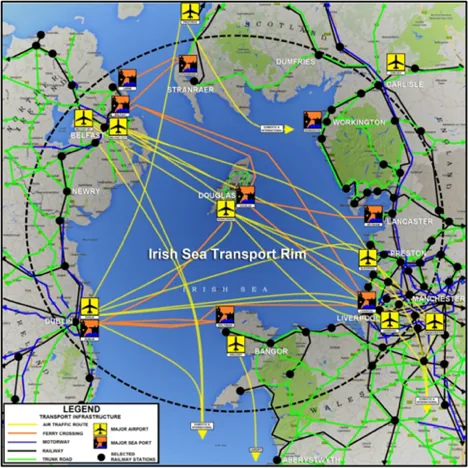
Given the extensive activity in green shipping ongoing across the Irish Sea Rim, there are possibilities for an integrated Irish Sea Green Corridor Network (Figure 8.2). Existing and potential synergies include:
- MULTI-CORRIDOR PROJECTS: Liverpool–Belfast and Dublin–Holyhead are already advancing green corridor pilots2. Linking these with Glasgow and Cork creates a loop of decarbonised trade routes.
- SHARED INFRASTRUCTURE: Ports can co-invest in shore-side power, alternative fuel bunkering, and digital logistics platforms, reducing duplication and accelerating rollout.
- POLICY ALIGNMENT: The network benefits from the Clydebank Declaration, UK’s Sixth Carbon Budget, and the EU Green Deal, creating a unified regulatory and funding landscape.
- INNOVATION ECOSYSTEM: Universities, consultancies, and operators across the region (e.g. Ricardo, Maynooth University, Connected Places Catapult) are already collaborating on pilot projects. Expanding this coalition boosts R&D workforce training.
Figure 8.2: An Irish Sea Rim Green Corridor Network
Port | Role in the Network | Green Potential |
Liverpool | Innovation hub and logistics gateway | Shore-side power, smart port logistics |
Belfast | Industrial anchor with strong hinterland links | Port-rail integration, alternative fuels |
Dublin | High volume Roll-on / Roll-off and passenger traffic | E-methanol trials, zero-emission ferry route |
Holyhead | Strategic UK-Ireland connector | Infrastructure upgrades, clean propulsion |
Glasgow | Expansion node via Clyde corridor | Hydrogen innovation, shipbuilding expertise |
Cork | Southern Gateway with EU alignment | EU funding access, offshore renewables |
MERSEY MARITIME
Mersey Maritime is a key organisation for establishing and supporting green shipping corridors in the Irish Sea Rim. It is an award-winning regional cluster organisation with supply chain expertise for and within the maritime industry across the Liverpool City Region and the greater North West. Mersey Maritime’s mission is to continue to be a catalyst for growth, influencing policy and driving change for the good of the maritime sector.
Mersey Maritime was conceived over twenty years ago to create an ecosystem, championing and supporting one of the most diverse maritime regions in the UK. Created as a not-for-profit organisation with more than 200 active members, it spans more than 33 sub-sectors of maritime and its related supply chain including ports, shipping, offshore, engineering, professional services, logistics, manufacturing and academia.
Maritime in Liverpool boasts the first commercial wet dock built in 1715, it is a sector worth £5bn+ supporting 48,000 jobs, Liverpool is the UK’s primary transatlantic port with 50% of UK-US trade and it is the 3rd busiest estuary in the UK (behind London and the Humber).