The Irish Sea Rim Investment, Innovation, and Enterprise Zone is a powerful driver of regional and national economic growth. The creation of nation innovation and investment strategies across the countries and regions within the Zone, means that there has never been a better opportunity for creating cross-border, cross-sector place-based transformation that can shape the prosperity and international position of the region. With a distinct strand that focuses on place activation and innovation, the Irish Sea Rim Place Programme will bring social, environmental, and connected hyper-local regeneration that actively brings communities together through internationally significant sporting events, regenerative tourism, high-street initiatives, creative storytelling programmes, and campaigns.
THE CHALLENGE
 Both the opportunities and barriers for transformation lie in the diverse nature of the economic, social, and environmental challenges prevalent across regions, nations, and continents. No one sector, academic institution, city or region can create and implement solutions at sufficient scale or complexity to fully leverage the opportunities. Existing innovation and investment models risk concentrating wealth and contributing to social inequalities and imbalances of funding. A lack of connectedness both within and across sectors leads to gaps in procurement and supply chains, causing delays, lost productivity, and additional costs. Cultural and communication gaps between nations, government, business, and academia, as well as a separation from community, creates barriers to exploitation of research and innovation, and realisation of benefit to the wider population. There are significant gaps in skills, with a drain from rural communities to cities and, in the UK, to the Greater South East.
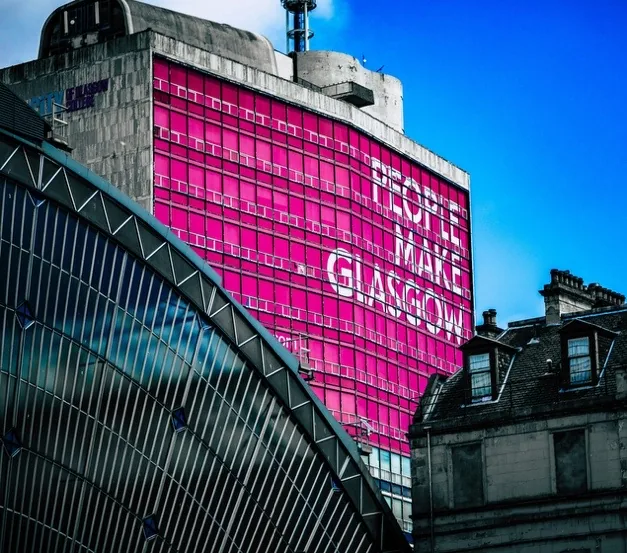
Glasgow. Image Credit: Artur Kraft on Unsplash
As described elsewhere in this report, within the current innovation and economic landscape there are also significant challenges relating to regional economic imbalances, fragility of the economic base, low productivity, and structural inequalities within communities (Sections 14-18). The traditional triple-helix model of government, business, and academia risks prioritising technical and economical outputs over social well-being and environmental sustainability. The defining challenge across the Irish Sea Rim is a ‘dual economy’. In our great cities – Liverpool, Manchester, Belfast, Glasgow, Cardiff, Dublin – dynamic, high-growth, knowledge-based sectors thrive. Yet, often only miles away, lie some of the most deprived communities in Western Europe. The prosperity generated in the science parks and creative quarters is not reaching the people in post-industrial towns, coastal villages, and overlooked urban neighbourhoods. In addition, the innovation potential of these towns, villages and urban neighbourhoods is both under-estimated and unrealised, deepening the cultural assumptions about what places and people are to be invested in. There is a clear priority for place- and needs-based initiatives and innovations to catalyse inclusive growth.
THE OPPORTUNITY
The post-Brexit landscape, combined with global economic uncertainty demands new models of regional development that are less dependent on traditional centralised structures. The nature of the Irish Sea Rim, as an apolitical, neutral cross border organisation with expertise in innovation, place, and technology, and a startup mindset, means that we are uniquely positioned to build a new approach to innovation and regional development in partnership with diverse stakeholders across the six jurisdictions of the Irish Sea region.
Our ISR50 Strategic Vision (Section 2) and novel Operational Framework (Section 22) provide the essential key to unlocking the potential of the Irish Sea Rim Investment, Innovation, and Enterprise Zone by fostering a dynamic, interconnected, and values-driven ecosystem that can learn, adapt, and evolve organically. There has never been a better time to formalise and empower the Irish Sea Rim so as to seize the opportunities created by recent global upheaval and build a more prosperous and resilient future.
CREATING INCLUSIVE GROWTH
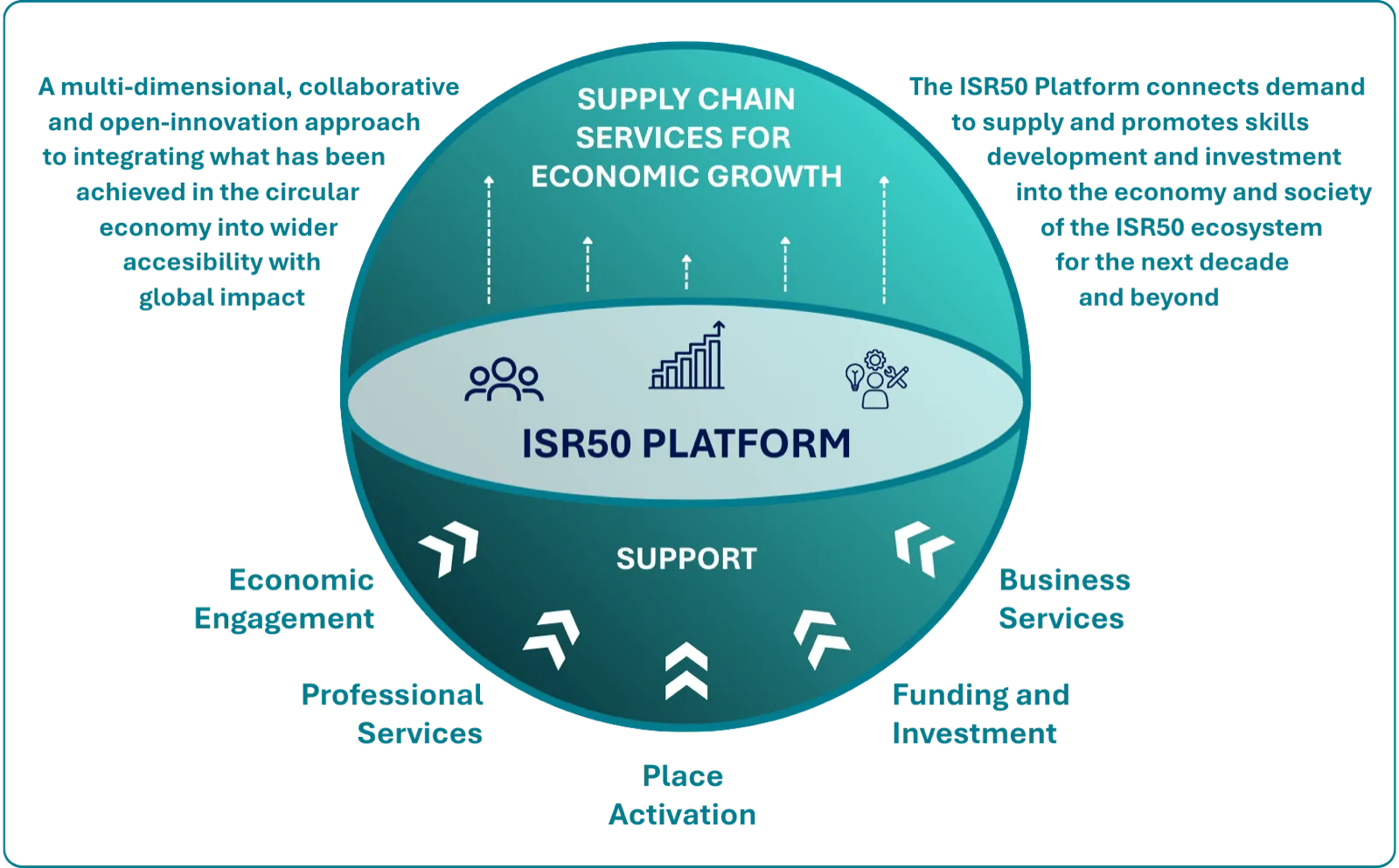
To tackle the challenge of inclusive growth, the Irish Sea Rim champions a Quadruple Helix model, which introduces a crucial fourth element: places and their communities (Figure 21.2). However, we seek to evolve this model beyond simple engagement and consultation towards genuine community co-production, empowering communities as equal partners from the beginning, working in partnership to identify needs, design solutions, deliver projects, drive impact, and share benefits. This approach ensures that development is done with and by communities, not to them. It places the lived experience and aspirations of local people at the heart of innovation and investment, ensuring initiatives are grounded in real-world needs, command local support, and deliver meaningful transformation which lasts beyond the timeframe of the project.
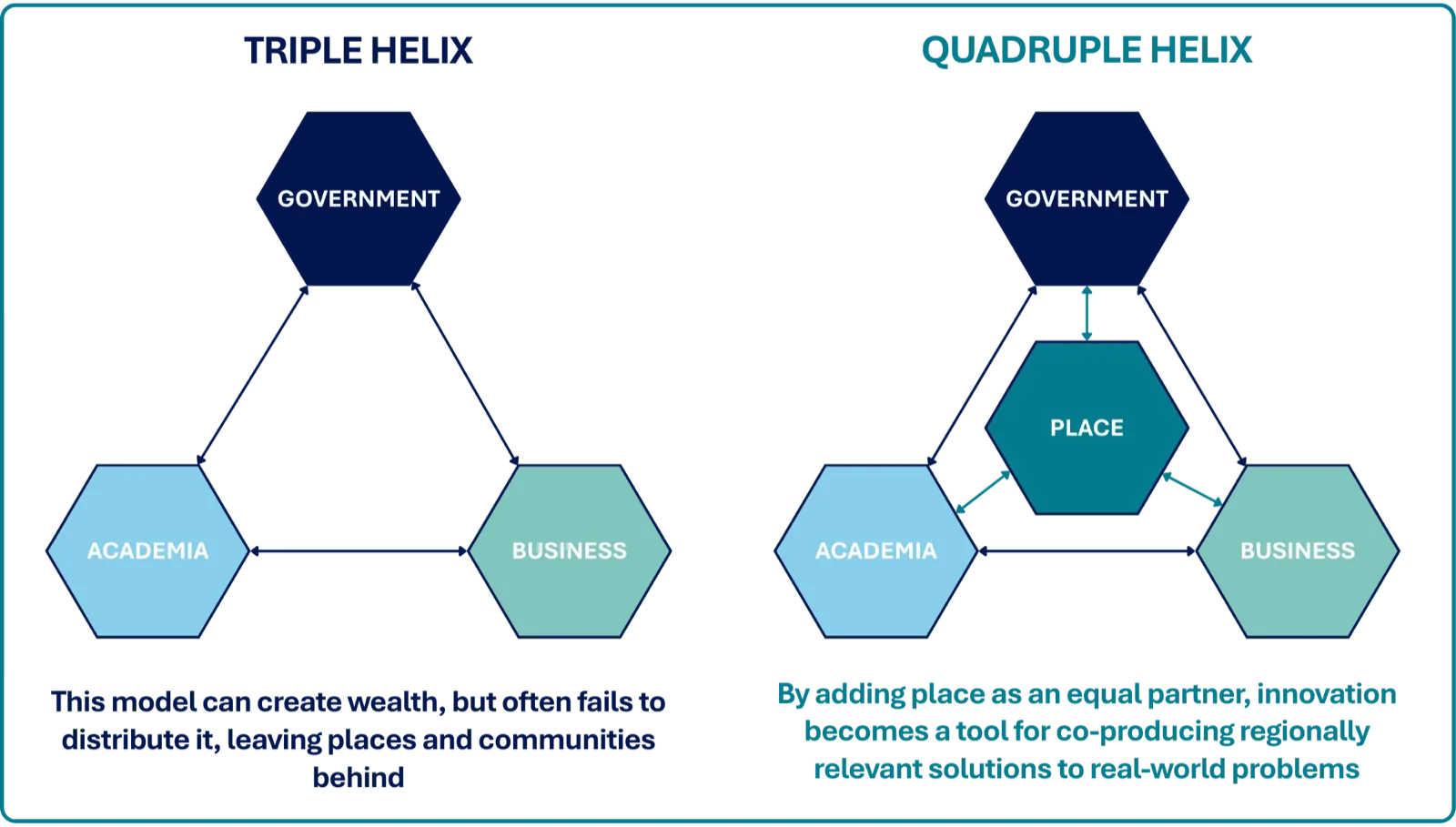
Our unique methodology is not built on a single doctrine but is informed by pioneering global frameworks that challenge traditional economic models.
- We draw inspiration from Doughnut Economics, which provides a powerful lens for ensuring our activities operate within a safe social and ecological space – meeting fundamental human needs (the ‘social foundation’) while respecting our planet’s limits (the ‘ecological ceiling’).
- We are guided by the place-based innovation strategies of economists like Dan Breznitz, who argue that regions must build on their unique, existing strengths rather than trying to imitate a generic Silicon Valley model.
- We support the creation of ‘Antifragile’ economies, as described by Nassim Taleb, within the Irish Sea Region and across the nations as a whole which are able to flex, adapt, and benefit from external shocks, rather than simply withstand them.
- Our principles and values are based on the Utropia principles developed by Nigel Catterson enabling us to build partnerships founded on mutual trust and shared success, supporting partners and communities to achieve long-term benefit and growth
By blending these concepts with our core commitment to community and stakeholder co-production across sectors and borders, the Irish Sea Rim has developed a practical framework for turning economic growth into meaningful, sustainable prosperity for all (Sections 21 and 22). Our goal is to create an ecosystem where investment directly addresses community needs—better housing, secure jobs, improved health, and a restored natural environment. This approach forms the foundation of our transformational Operational Framework and Bridge Model for innovation, which will create the foundation for a series of ambitious, cross-border flagship projects designed to pilot and prove this new way of working.
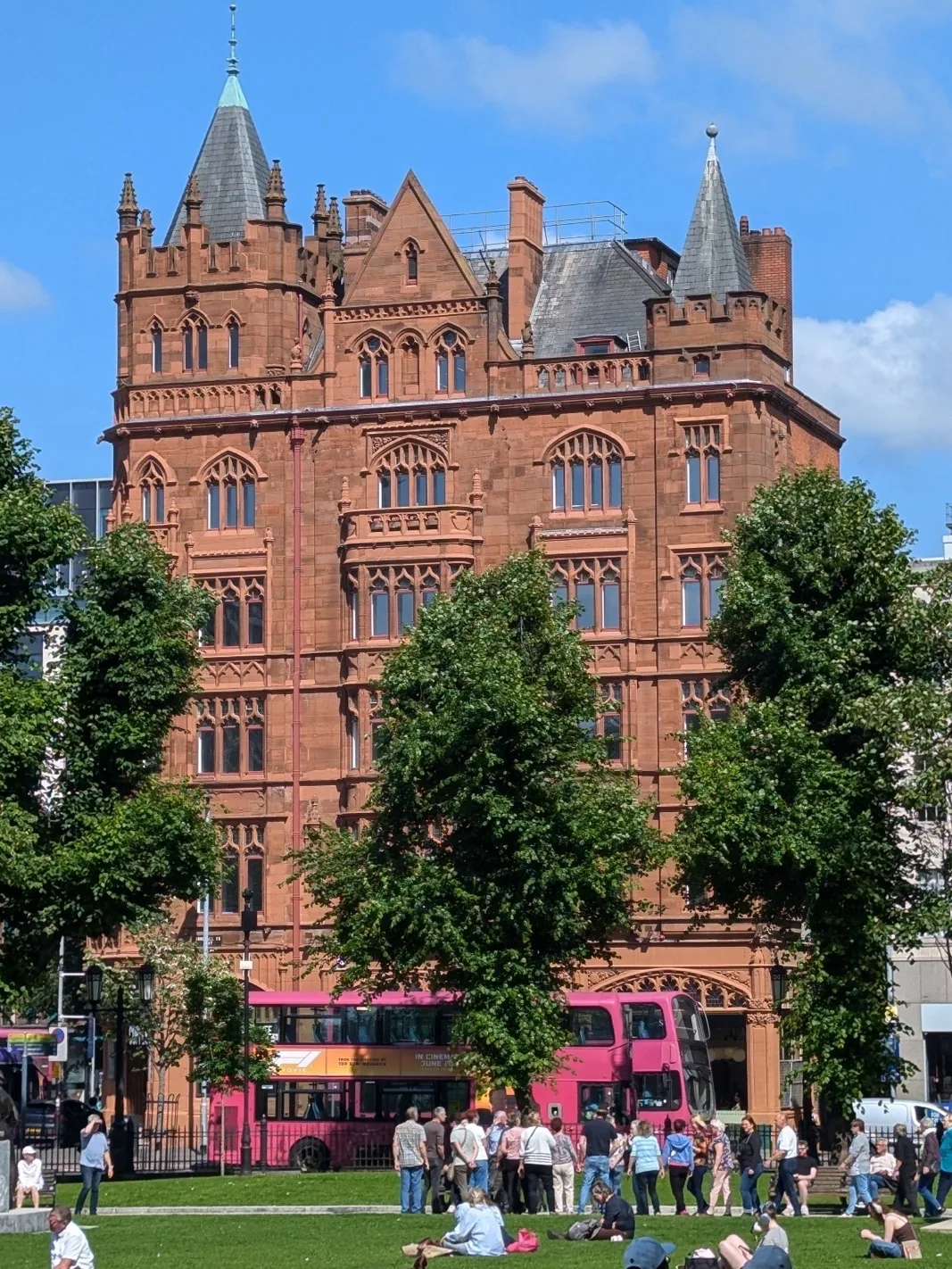
Belfast, Image Credit: Irish Sea Rim