The UK Freeport Programme is a major initiative designed to boost investment in historically underserved parts of the country. Known as Green Freeports in Scotland, these special areas are strategically located and tailored to local strengths to foster innovation, economic growth, and job creation. All Freeports are focused on promoting a low-carbon economy and developing the green energy sector. Four of the UK's twelve Freeports are located within the Irish Sea Rim area.
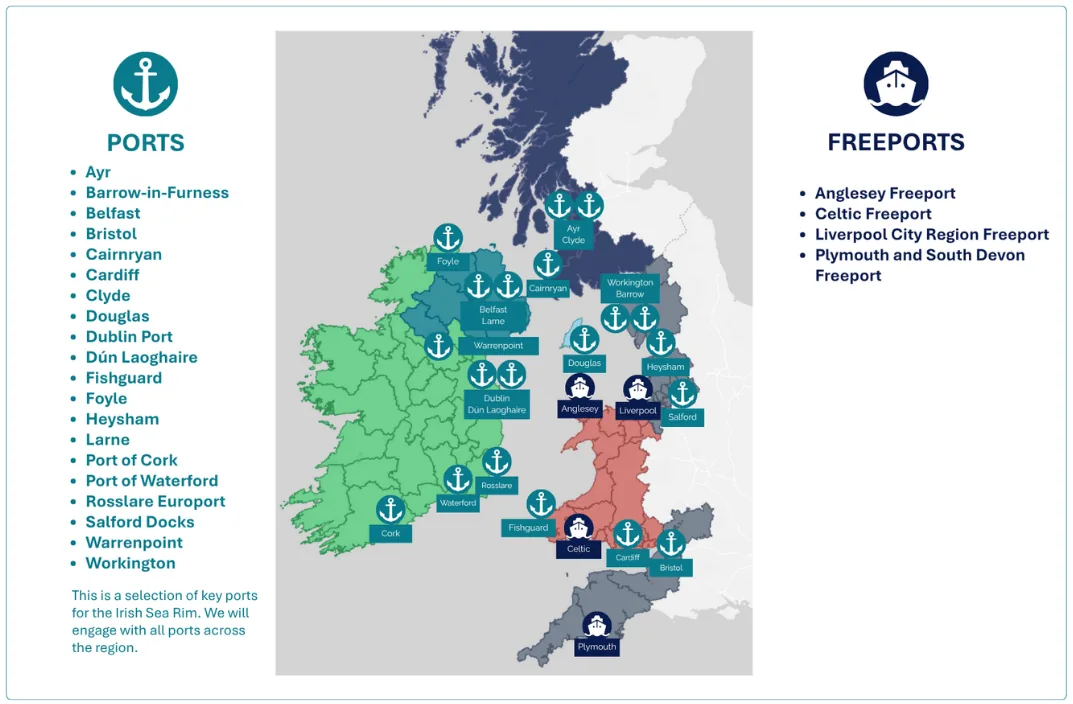
LIVERPOOL CITY REGION FREEPORT
LIVERPOOL CITY REGION FREEPORT:
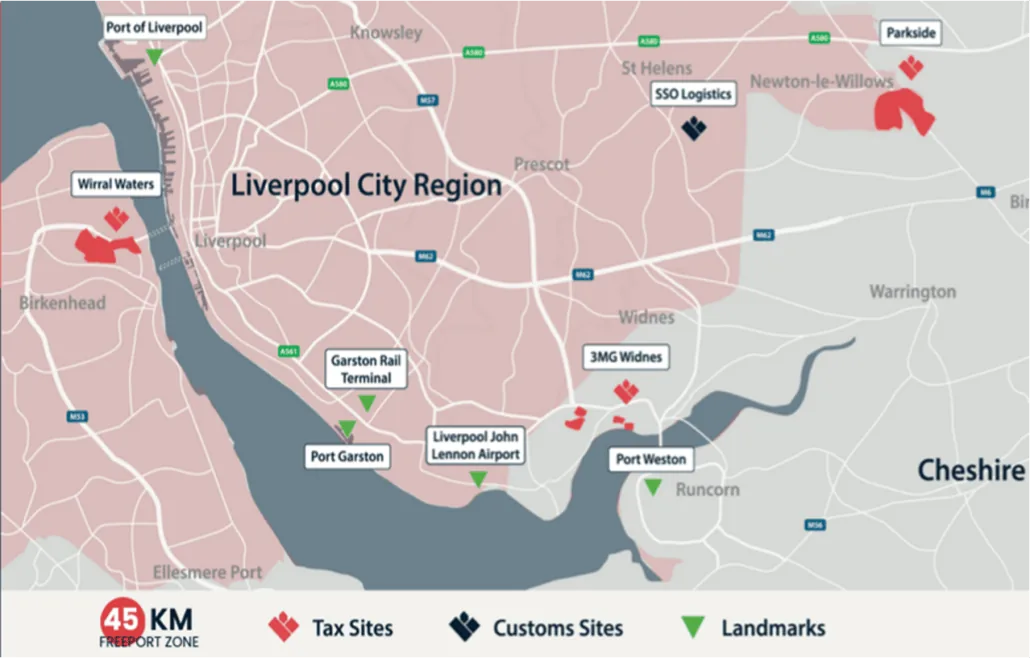
The Liverpool City Region (LCR) Freeport is the UK's leading transatlantic port and is strategically vital for trade with the Americas, handling 45% of UK trade from the US. As a major gateway on the Irish Sea and with its multi-modal logistics capabilities, it is an essential partner for strengthening the entire Irish Sea region's economic connectivity.
- GEOGRAPHY AND LOGISTICS: The Freeport is a 45km diameter multi-modal zone on the west coast of England with direct access to the Irish Sea, integrating deep-water port facilities with extensive road, rail, and inland waterway connections.
- STRATEGIC VISION: Target industries include advanced manufacturing, logistics, and low-carbon industries. The strategy is aligned with the region's goal to reach net zero by 2040, fuelling social mobility, innovation, and inclusion.
- SKILLS AND JOB CREATION: Recognised by the Financial Times' fDi Intelligence as a "Rising Star," the Freeport is estimated to add £850 million to the local economy, create 14,000 jobs, and operate at the highest sustainability standards.
ANGLESEY FREEPORT
Anglesey Freeport is crucial for maintaining efficient trade with Ireland, the UK's closest trading partner. Its focus on marine renewable energy and its role as a key logistics hub make it an indispensable partner for the Irish Sea Rim. A key initiative is the new "Digital Trade Corridor" on the Holyhead-Dublin route to streamline the flow of goods.
- GEOGRAPHY AND LOGISTICS: Located on the north-west coast of Wales, its main asset is the Port of Holyhead, a major roll-on/roll-off ferry port operated by Stena Line that is a vital node for trade between Ireland and mainland Europe via the UK, a route of significant economic importance.
- STRATEGIC VISION: The Freeport has a dual focus: becoming a global leader in low-carbon energy by building on the "Energy Island Programme," and maximising the logistical capacity of Holyhead port to enhance trade flows.
- KEY DEVELOPMENT: Core partners Stena Line and Isle of Anglesey County Council are redeveloping the 200-acre derelict Prosperity Parc site to attract commercial investment and create local jobs.
CELTIC FREEPORT
The Celtic Freeport is of strategic importance for the UK's energy security and net-zero ambitions, aiming to secure a first-mover advantage in the global floating offshore wind (FLOW) market. Its focus on marine renewables offers a strong basis for collaboration in research, supply chain development, and skills-building across the Irish Sea region.
- GEOGRAPHY AND LOGISTICS: Spanning over 500 hectares of developable land in South-West Wales, and with strong multi-modal connectivity, it includes the deep-water ports of Milford Haven and Port Talbot, providing direct access to the Celtic Sea's significant wind resources.
- STRATEGIC VISION: Create a green investment and innovation corridor, building on extensive skills base, transmission, and pipelines to accelerate Wales’s low carbon economy transition. Support FLOW roll-out and establish a future based on the hydrogen economy, alternative fuels, carbon capture, and cleaner steel.
- SKILLS AND JOB CREATION: Expected creation of 16,000 green jobs and up to £5.5 billion investment for new industrial capacity and a local legacy fund for training young people and upskilling the existing workforce for the jobs of the future.
PLYMOUTH AND SOUTH DEVON FREEPORT
This Freeport is of national importance for cementing UK leadership in high-tech maritime sectors like marine autonomy and defence and is critical for capturing a share of the future ocean economy, predicted to double to $3 trillion by 2030. Plymouth offers a unique opportunity for a world-leading research and innovation network for marine data collection, analysis, and development of autonomous maritime systems.
- GEOGRAPHY AND LOGISTICS: Located in South-West England, it has a deep-water harbour with direct access to the Atlantic and English Channel and over 1000km² of authorised water space for testing autonomous systems.
- STRATEGIC VISION: Create an innovation cluster for high-value manufacturing in the marine, defence, and space sectors, with a focus on clean growth. Key initiatives include the Langage Green Hydrogen Hub and testing Marine Autonomous Vessels in Smart Sound Plymouth. Infrastructure developments include increasing freight capability through doubling wharf load capacity.
- SKILLS AND JOB CREATION: Provide a pipeline of around 3,500 jobs, from entry-level to highly skilled roles.
FORTH GREEN FREEPORT
Forth Green Freeport is critical for achieving Scotland's 2045 net-zero target by demonstrating a viable pathway for decarbonising heavy industry while creating growth in green technologies. Though located on the North Sea, its focus on advanced manufacturing, hydrogen, and offshore wind supply chains presents significant collaboration and market opportunities for the Irish Sea Rim project and businesses.
- GEOGRAPHY AND LOGISTICS: The Freeport is a strategically significant 45-kilometre- zone on Scotland's east coast, encompassing a network of industrial and logistical assets including the ports of Grangemouth, Rosyth, Leith, and Burntisland, as well as Edinburgh Airport. It will drive a hydrogen economy and alternative fuels cluster in Grangemouth, bolstered by new freight, rail and alternative fuel terminals.
- STRATEGIC VISION: Catalyse Scotland's net-zero economy transition, focusing on central belt reindustrialisation and offshore wind, advanced manufacturing, logistics, and shipbuilding. Investments will expand logistics and trade capacity, renewables manufacturing, alternative fuels and carbon capture and storage.
- SKILLS AND JOB CREATION: Creation of up to 34,500 jobs locally and across the UK supply chain, focusing on high-quality jobs in areas of local deprivation. Benefits will be reinvested into communities through skills programmes and SME innovation hubs. An innovation network will connect research and business.
HUMBER FREEPORT
The Humber Freeport is vital to the UK's goal of deploying 40 GW of offshore wind by 2030 and its broader net-zero goals, representing a major partner in building a national green-tech supply chain, enhancing economic resilience and reducing dependence on volatile international markets. Connecting the Freeport with Irish Sea region ports and innovation hubs could create a powerful, integrated economic axis across the UK.
- GEOGRAPHY AND LOGISTICS: On England's east coast, the UK's busiest port complex by tonnage, handling 17% of the nation's trade. 75% of UK manufacturing sites are within a four-hour drive of the ports of Hull, Goole, Immingham, and Grimsby.
- STRATEGIC VISION: A world-leading offshore wind hub, with strengths in logistics and advanced manufacturing. Key projects include hydrogen and rare earths plants, expansion of offshore wind blade manufacturing, and deep-water quays.
- SKILLS AND JOB CREATION: Projections forecast the creation of 7,000 new jobs and £650 million in investment.
INVERNESS AND CROMARTY FIRTH GREEN FREEPORT
This Freeport is of national importance for delivering the UK's offshore wind targets, particularly in the global FLOW market. It represents a "just transition" by leveraging the region's oil and gas legacy to build a new sustainable energy industry.
- GEOGRAPHY AND LOGISTICS: A consortium in the Scottish Highlands including the Port of Cromarty Firth and the Port of Nigg. It is billed as Europe's largest heavy engineering cluster and largest green engineering development area in the UK, with sheltered deepwater access ideal for the renewables sector.
- STRATEGIC VISION: Key sectors are FLOW, heavy marine engineering, and green hydrogen. Major investments include a £350 million cable factory by SUMITOMO and a £300 million commitment into Ardersier Port. Associated British Ports are exploring the creation of energy related infrastructure across a 60-hectare site.
- SKILLS AND JOB CREATION: Forecast creation of 16,500 jobs across the UK, with 12,250 located directly in the Highlands. The PowerHouse hub has been created to support supply chain and workforce development.
TEESSIDE FREEPORT
Teesside Freeport is a critical test case for the UK's industrial decarbonisation strategy and transforming industrial sites into clean energy hubs. Teesside offers supply chain opportunities and a valuable case study in managing industrial transition.
- GEOGRAPHY AND LOGISTICS: Located in North East England, this is the UK's largest freeport, covering 4,500 acres. It includes Teesworks), Teesside International Airport, and the ports of Hartlepool and Teesport.
- STRATEGIC VISION: A flagship project for the UK's low-carbon transition. Anchor projects include SeAh Wind's £650 million offshore wind turbine base factory and the UK's premier carbon capture (CCUS) project, Net Zero Teesside.
- SKILLS AND JOB CREATION: Estimated creation of 18,000 new jobs and £3.2 billion boost to the local economy. The Teesworks Skills Academy was created to support employers and develop a world-class local workforce. In connection to TVCA’s Digital and Creative-focused Investment Zone, Tees Valley and Teeside Freeport hold a unique role in contributing to place-focused innovation across regenerative tourism, sustainability in screen and wider creative industries and high street regeneration.