The Strategic Innovation Landscape
The Irish Sea region constitutes a unique geopolitical and socio-economic space, encompassing six distinct governmental jurisdictions: the United Kingdom government (representing England and setting UK-wide policy in reserved areas), the devolved governments of Scotland, Wales, and Northern Ireland, the government of Ireland, and the government of the Isle of Man self-governing Crown Dependency. These nations and regions are bound by deep historical ties, intricate cultural connections, and significant economic interdependence, yet they also exhibit political divergence and operate within varied constitutional frameworks.
Understanding the stated priorities of each government is crucial, particularly in the contemporary context shaped by the United Kingdom's departure from the European Union, the ongoing recovery from the COVID-19 pandemic, and the pressing global challenges of climate change, energy security, economic volatility, geopolitical uncertainty, and rapid technological disruption. The need for effective intergovernmental and inter-regional cooperation remains paramount for regional stability, productivity and prosperity, and interconnected place-based innovation is consistently viewed as a vital tool for achieving diverse economic, societal, and cultural goals.
UK-IRELAND SUMMIT
The UK-Ireland Summit in March 2025 marked a significant step forward in the relationship between the two nations, signalling a renewed commitment to partnership and cooperation. The summit, led by Prime Minister Keir Starmer and Taoiseach Micheál Martin, aimed to move beyond the recent challenges posed by Brexit and establish an ambitious program of collaboration through to 2030. The overarching theme was one of mutual respect and a shared vision for a prosperous and secure future for both nations.
The summit was set against the backdrop of new political landscapes in both the UK and Ireland. With a new government in the UK, there was a clear intent to "reset" the relationship with Ireland and the wider European Union. This was seen as crucial for stabilising the political and economic environment, particularly in relation to Northern Ireland and the implementation of the Windsor Framework to simplify trade between Great Britain and Northern Ireland.
Operationally, the summit focused on establishing concrete frameworks for cooperation across a range of sectors. This included the creation of new dialogues and exchanges to facilitate knowledge sharing and joint initiatives. The emphasis was on practical, tangible outcomes that would deliver real benefits to people and businesses in both countries.
The joint statement released after the summit detailed a comprehensive set of objectives, underscoring the depth and breadth of the renewed partnership. These are summarised below:
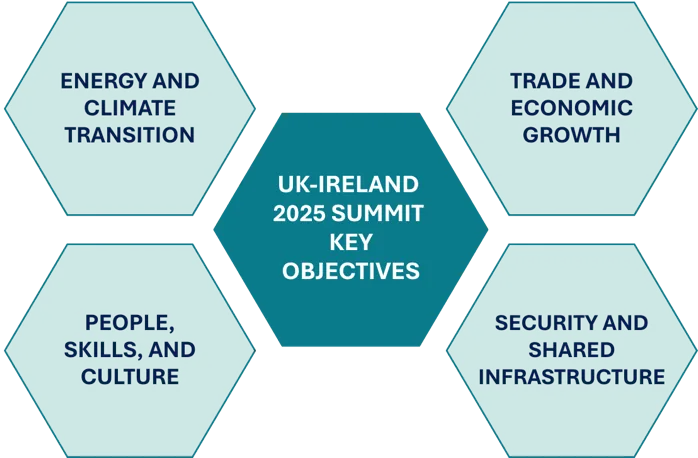
- SECURITY AND SHARED INFRASTRUCTURE: A strengthened commitment to working together on the global stage, including on peacebuilding, security, and defence. This included a specific focus on maritime and cybersecurity to protect shared interests.
- ENERGY AND CLIMATE TRANSITION: A joint ambition to harness the renewable energy potential of the Celtic and Irish Seas. This involves collaboration on offshore energy projects, data sharing, and the decarbonization of the maritime sector.
- TRADE AND ECONOMIC GROWTH: A plan to build on the already strong economic ties to attract investment and drive growth. This includes new frameworks for infrastructure development, support for SMEs, and collaboration in science and innovation.
- PEOPLE, SKILLS, AND CULTURE: A commitment to deepening the connections between the people of the UK and Ireland. This includes a new strategic partnership between cultural institutions, joint hosting of major sporting events, and the establishment of a youth forum.
The Summit also voiced a shared ambition for a peaceful and prosperous Northern Ireland. This involves continued support for the Good Friday Agreement and the delivery of the PeacePlus program to promote reconciliation and economic development
The Irish Sea Rim has the potential to play a pivotal role in realising the objectives of the summit and helping to reshape the region's economic and social geography. Our power lies in our ability to work effectively at both strategic and operational levels, forming conduits between high level diplomacy and place-based implementation, driving impact through a durable, cross-border network of places, universities, and businesses. This allows momentum to be built from the ground up, making the partnerships and initiatives more resilient to shifts in national and global political climates
The Irish Sea Rim’s core mission is to re-imagine the Irish Sea not as a barrier that divides, but as the central organising principle of a coherent, functional economic region. This principle is critical for achieving success across all the summit's strategic priorities. By establishing a unified platform for communication, collaboration, and co-production, the Irish Sea Rim can reduce the complexity and friction inherent in cross-border ventures, whether in infrastructure, life sciences, or digital technology. It creates the critical connections and bridges that support the pooling of research and development capabilities from the region's universities and the formation of globally competitive innovation ecosystems. This approach transforms a collection of separate coastal economies into a powerful and integrated Investment, Innovation, and Enterprise Zone. In doing so, the Irish Sea Rim can provide an essential mechanism to transform the high-level political and economic ambitions of the summit into a shared, sustainable, and prosperous reality.
GOVERNMENTAL STRATEGIC PRIORITIES
There is significant alignment between the strategic priorities of Scotland, England, Wales, Northern Ireland, Ireland, and the Isle of Man, particularly around core themes of economic growth, public service improvement, and the transition to a green economy.
- ECONOMIC GROWTH AND PROSPERITY: Through the Modern Industrial Strategy[45], the UK Government’s mission is to achieve the highest sustained growth in the G7. In Scotland, economic growth is a priority alongside eradicating child poverty. Northern Ireland’s focus is on a globally competitive and sustainable economy, while Wales seeks green jobs and growth. Ireland’s National Development Plan aims to boost international competitiveness, and the Isle of Man has set a GDP target of £10 billion by 2032.
- CLIMATE CHANGE AND THE GREEN ECONOMY: The UK Government has a mission to make Britain a clean energy superpower, Scotland is focused on investment in green energy, and Wales is creating green jobs to address the climate crisis with an aim for a net-zero NHS by 2030. Northern Ireland includes protecting the environment as a core priority. Ireland's infrastructure plan is designed to meet climate goals, and the Isle of Man aims to substantially decarbonise its services economy by 2030.
- IMPROVING PUBLIC SERVICES: This is a universal priority with a significant focus on delivering better healthcare for all, including cutting waiting times and hospital backlogs. More broadly, delivery of high quality, sustainable public services is intended to create greater efficiencies and improve quality of life.
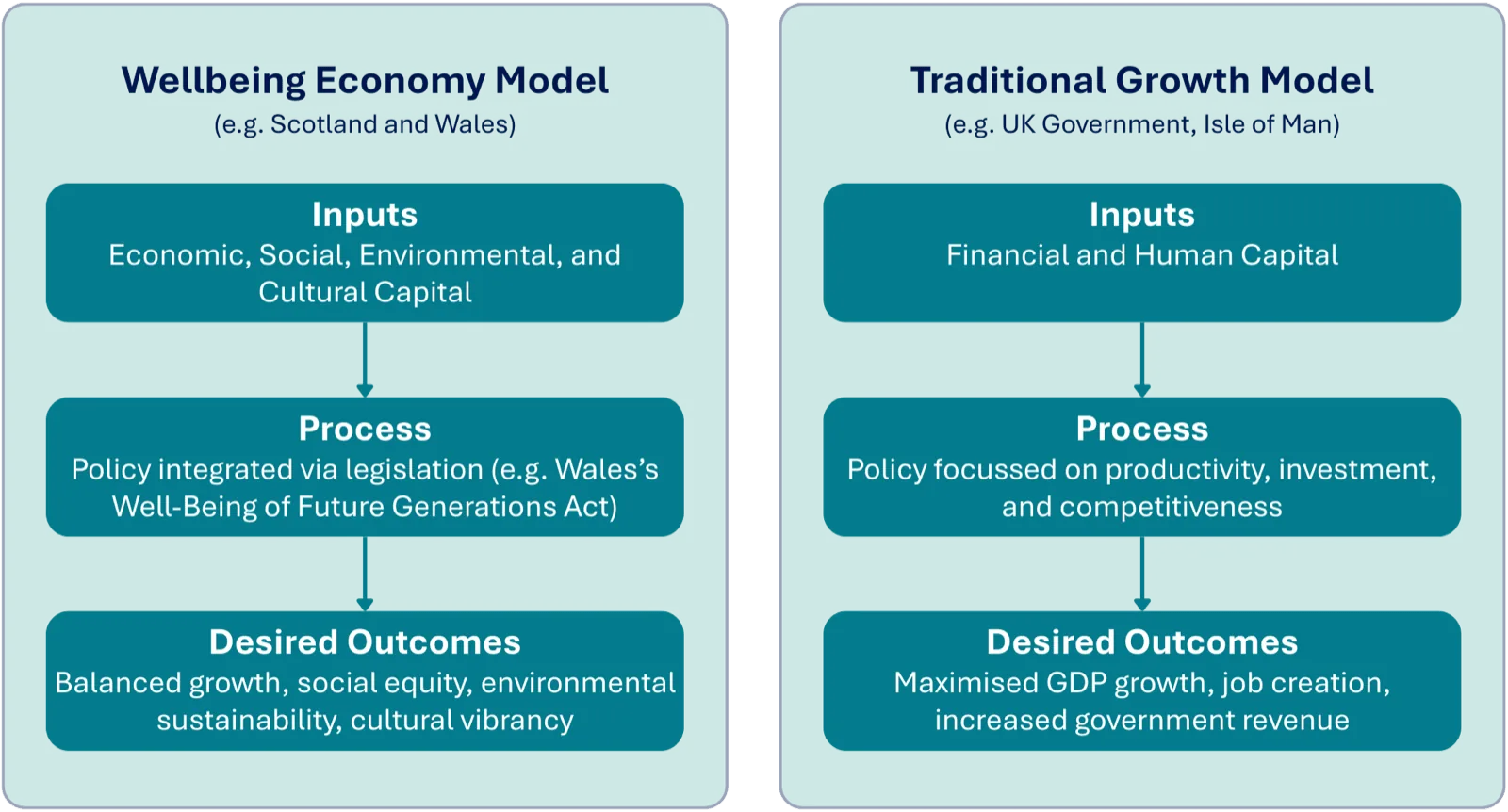
Despite these shared priorities, distinct differences in approach and emphasis exist across the six jurisdictions of the Irish Sea Rim, reflecting their unique political, social, and economic contexts. The most significant difference is the philosophical framework underpinning economic strategies (Figure 14.2). Both Scotland and Wales have explicitly adopted a “wellbeing economy “model”. Wales’s Well-being of Future Generations Act 2015, seeks to balance economic, social, environmental, and cultural outcomes, moving beyond traditional metrics like GDP[46]. In contrast, economic growth is the UK Government’s key priority, focussing on a more traditional growth model, while the Isle of Man has quantitative targets for GDP, job creation, and targeted population growth, seeing these as essential for maintaining a healthy and dynamic economy.
Northern Ireland’s priorities are shaped by its strategic economic drivers, climate plan, and infrastructure plan, with a focus on safer communities through social cohesion, underpinned by a Wellbeing Framework that includes an overarching commitment to peace. Ireland emphasises large-scale transformative infrastructure projects in energy, water, and transport as the primary enablers of all other national goals, from housing to competitiveness.
The Irish Sea Rim is uniquely positioned to support delivery of the strategic priorities of all six member governments, delivering sustainable, inclusive economic growth through cross-border collaboration and the creation of a unified, transnational Investment, Innovation, and Enterprise Zone. We work through our Board of Governors, comprising senior representatives from each country (Section 30), to understand each government’s unified and specific priorities and learn from previous experience, to design cross-border collaborative strategies and projects with mutually beneficial and agreed outputs, outcomes and impact. In this way we can support economic growth and the prosperity and wellbeing of all communities around the Irish Sea.
INNOVATION AND INDUSTRIAL STRATEGIES
The UK, Ireland, and Isle of Man each have distinct but complementary approaches to delivering on governmental priorities through innovation-led growth, targeting key sectors, and building robust ecosystems to support enterprise.
Ireland's cross-governmental Impact 2030 Strategy places research and innovation at the core of addressing national challenges. It is structured around five pillars: 1) Maximising the impact of research and innovation on the economy, society, and the environment; 2) Ensuring research and innovation structures support excellence and outcomes; 3) Driving enterprise success through innovation; 4) Placing talent at the heart of the research and innovation system; and 5) Strengthening all-island, EU, and global connectivity. This outward-looking approach is demonstrated through initiatives like the North-South Research Programme, which funds collaborations with Northern Ireland. Supporting policies include the National Smart Specialisation Strategy for regional innovation and Global Citizens 2030 to attract international talent.
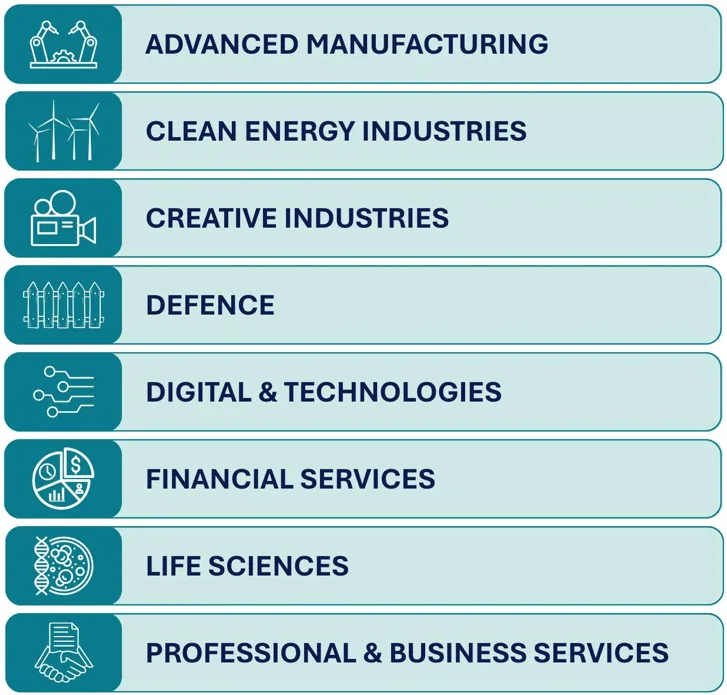 The UK’s Modern Industrial Strategy 2025 is a ten-year plan designed to increase business investment and cultivate the industries of the future. The strategy is built around targeted support for eight priority growth-driving sectors where the UK has, or can build, a comparative advantage: Advanced Manufacturing, Clean Energy Industries, Creative Industries, Defence, Digital and Technologies, Financial Services, Life Sciences, and Professional and Business Services. The strategy is centred around a place-based approach, concentrating support in specific Industrial Strategy Zones. The Modern Industrial Strategy is reinforced by a commitment to raise public R&D spending to £22.6 billion per year by 2029/30, focusing on frontier technologies like AI and quantum computing.
The Isle of Man Government integrates innovation as a central theme within its overarching 10-15 year Our Island, Our Future economic strategy. The vision is to increase productivity and strengthen and diversify the economy via innovation- and business focussed initiatives, such as digital and technology adoption, business growth support programmes. The strategy combines protecting and growing existing key sectors, while targeting investment to grow new sectors such as the knowledge, data, and green economies.
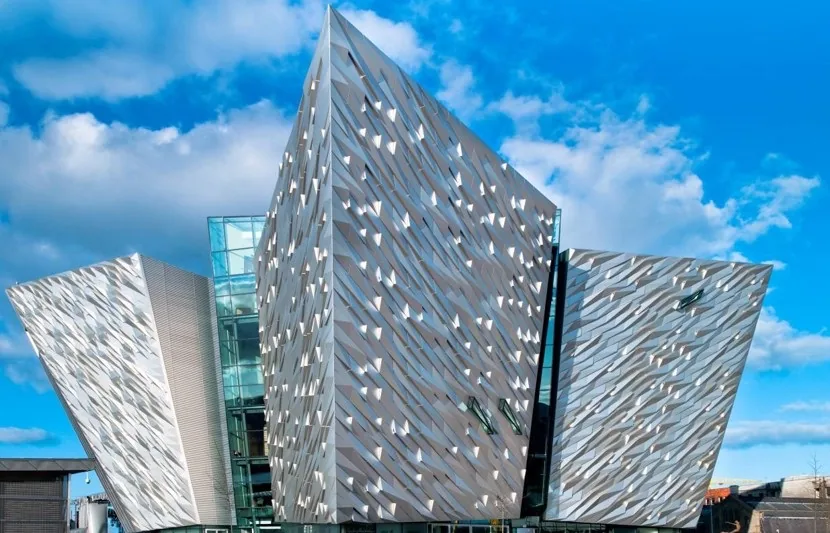
Titanic Belfast, Image credit: Irish Sea Rim