The Irish Sea Rim Bonded Land Bridge is a proposed flagship logistics and trade innovation project designed to restore speed, reliability and strategic value to the movement of freight between mainland Europe and Ireland via Great Britain. Before Brexit, the UK land bridge operated as a highly efficient internal market route, allowing freight from the Netherlands, Belgium and northern France to move rapidly across the UK road and rail network before crossing the Irish Sea to Dublin, Belfast and other Irish Sea ports. Brexit fundamentally changed this operating environment. Great Britain is now a third-country customs territory between two EU points, creating a “double border” problem for EU-Ireland freight using the UK as a transit route. The result has been a shift of some traffic to direct Ireland-continental Europe ferry services, particularly for lower-value or less time-sensitive goods.
However, the UK land bridge remains strategically important because it offers a speed and frequency advantage that direct maritime routes cannot fully replicate. For time-critical sectors such as pharmaceuticals, fresh and chilled food, advanced manufacturing components, medical products, express logistics and just-in-time supply chains, the difference between an 18-22 hour transit and a 40-60 hour direct maritime alternative can materially affect inventory costs, shelf life, contract performance and supply chain resilience. The ISR bonded land bridge therefore repositions the route not as a return to the pre-Brexit status quo, but as a next-generation “smart corridor”: a secure, digitally integrated, customs-compliant and lower-carbon freight route connecting the Benelux, northern England, Wales, Ireland and the wider Irish Sea economy.
The regulatory basis for the project already exists. Under the Common Transit Convention, EU goods can move from one EU point to another via Great Britain using a T2 internal transit procedure, preserving Union customs status and avoiding double duty, provided the goods remain under customs supervision and are not interfered with while in the UK. For non-EU goods, T1 external transit can suspend duty until the goods reach their final customs destination. The challenge is therefore not whether a bonded land bridge is legally possible; it is whether the administrative, safety and security, sanitary/phytosanitary and data requirements can be made sufficiently frictionless for operators to choose the route at scale.
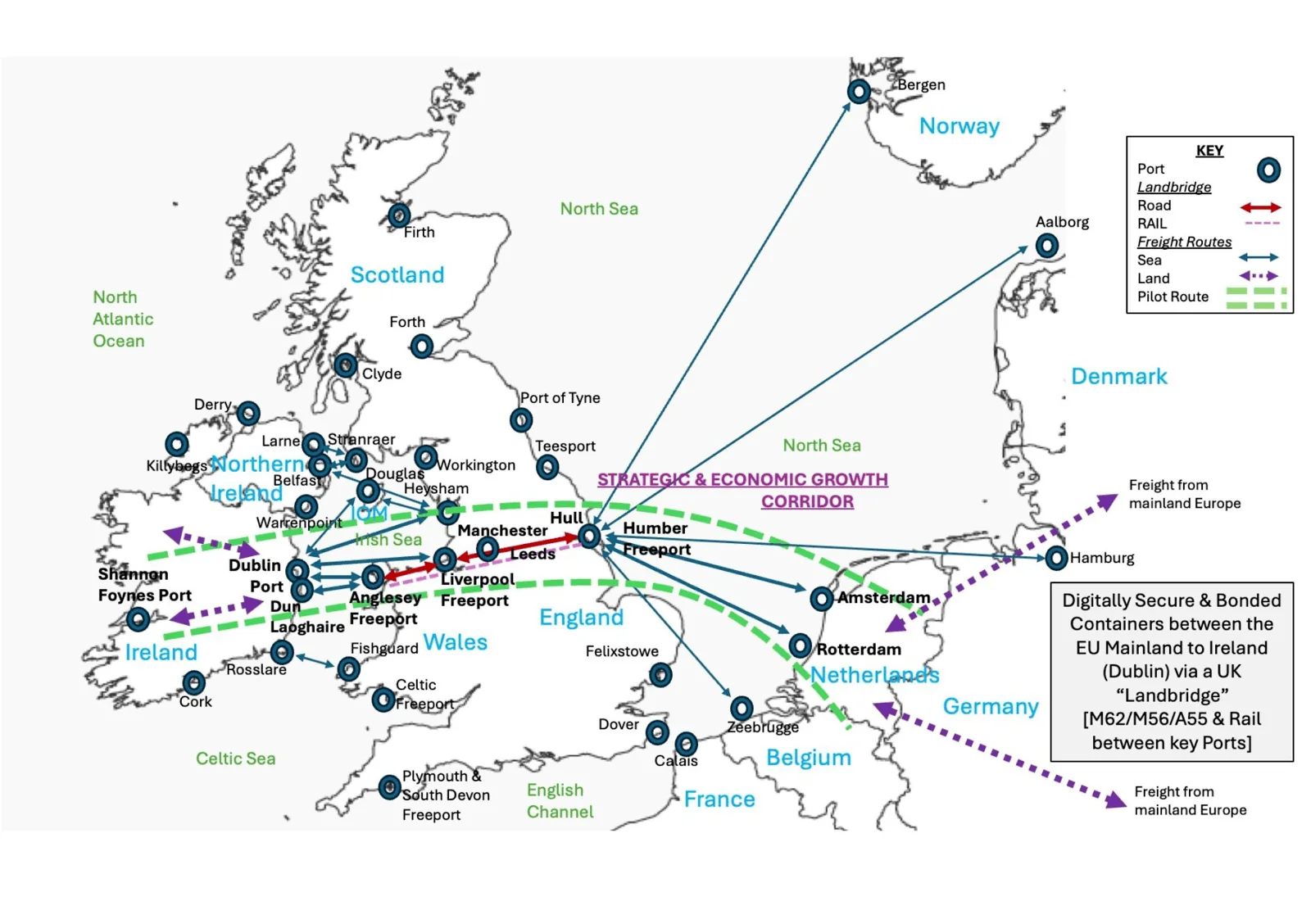
The ISR project addresses this challenge through systems integration. A current land bridge movement can require interaction with several disconnected systems. Re-keying the same data across multiple platforms increases cost, error rates, and delay risk, particularly for SMEs and groupage operators. The ISR proposition is to create secure and trusted digital trust pipeline which can connect data across multiple systems to create a seamless, monitored, bonded transport route through the UK (figure 12.1). The aim is not to bypass customs control, but to make lawful transit easier, auditable, and predictable.
Cybersecurity, satellite monitoring, and trusted data asset services have been built into the Bonded Land Bridge from the start. The Land bridge will be a critical digital logistics asset connecting customs authorities, port systems, ferry operators, hauliers, rail freight providers, freeports, insurers, consignors, and consignees. The risk profile includes data manipulation, ransomware, denial of service, GPS spoofing, compromised IoT devices, fraudulent seal events, identity misuse, and attacks on port or carrier interfaces. The project is based on a secure-by-design model: strong identity and access management; multi-factor authentication; API security; encryption in transit and at rest; event logging; tamper-evident audit trails; segmentation between operational technology and business systems; incident response protocols; and compliance alignment with UK maritime cyber guidance, NCSC good practice and EU NIS2 expectations for transport and critical infrastructure. Smart seals and IoT devices will form trusted border assurance devices whose integrity is central to the customs and SPS risk model.
Freight logistics will initially be organised around a small number of high-value pilot corridors. The most immediate road corridor is the east–west route from Rotterdam, Zeebrugge or Antwerp into Humber Freeport, across the M62 corridor to Liverpool Freeport, and onward to Dublin. A second strand would test an intermodal bonded corridor between Humber Freeport and Liverpool City Region Freeport, using rail for the cross-Pennine leg and sea freight at either end. This “Freeport-to-Freeport” model could create a secure bonded tunnel across northern England, reducing HGV mileage on the M62, improving resilience against driver shortages and road congestion, and aligning the land bridge with green shipping corridor investment on the North Sea and Irish Sea.
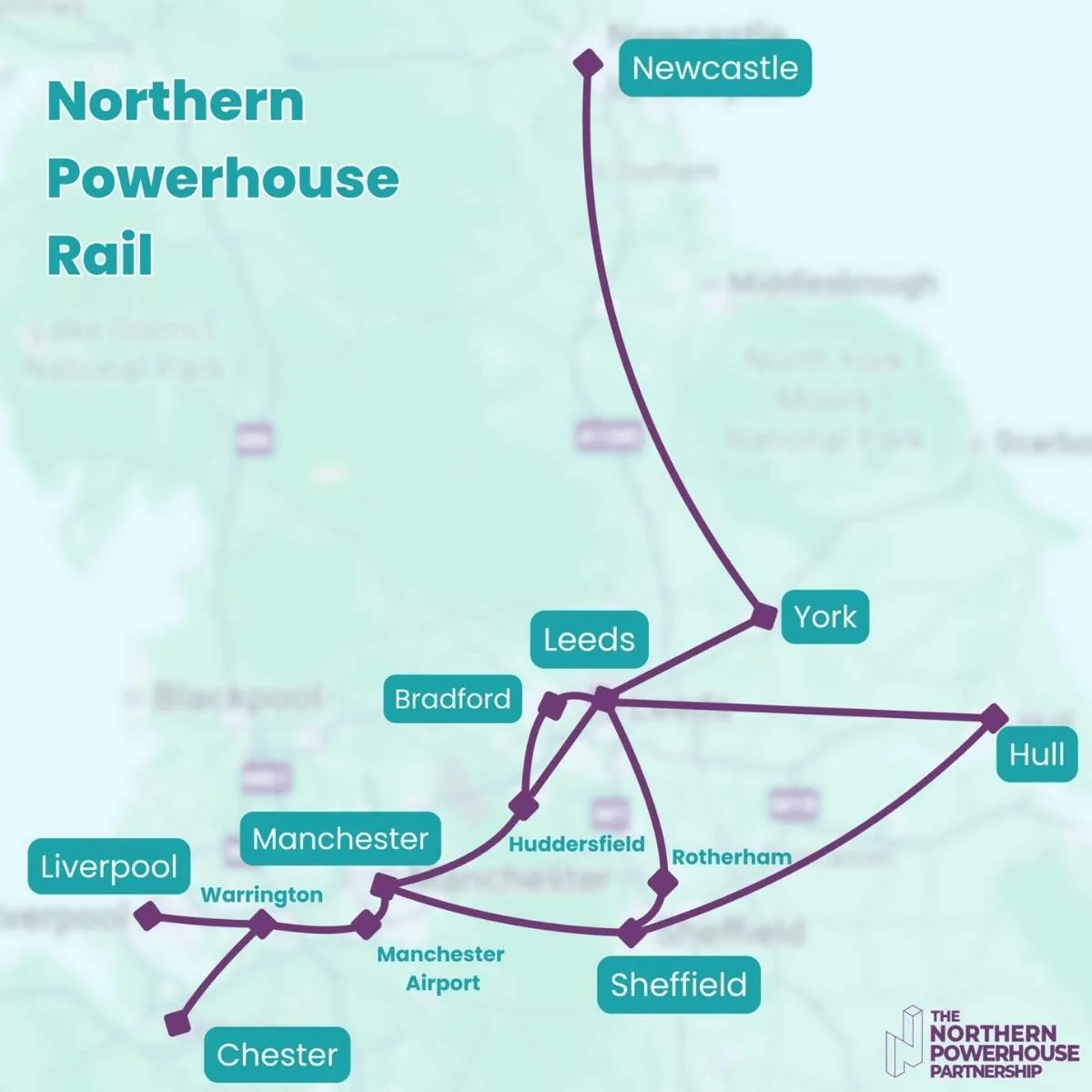
The M62 corridor and Transpennine rail network are therefore not peripheral infrastructure issues; they are central to the economic logic of the project. The M62 is the landside spine connecting the Humber and Mersey, two major maritime and industrial gateways. Its role in the pilot would be to support fast accompanied and unaccompanied RoRo freight, while identifying where digital pre-clearance, secure parking, EV/HGV charging, hydrogen refuelling, incident response and traffic management can improve reliability. In parallel, Transpennine rail upgrades – particularly freight gauge enhancements and the ability to carry high-cube containers more efficiently – could enable a lower-carbon bonded rail bridge between east and west coast ports. This creates the basis for a multimodal corridor that is not simply faster, but also greener, more resilient and more investable. The Irish Sea Rim Bonded Land Bridge should be integrated with future Northern Powerhouse Rail developments (Figure 12.2) to ensure further development and operation of a rail bridge.
The potential trade and GVA impacts are significant, and a key pilot project will be to model this through a full economic impact assessment. At minimum, the project could generate value through five channels.
- First, it could recover a proportion of high-value, time-sensitive EU–Ireland traffic that has been displaced to longer direct routes.
- Second, it could reduce total landed cost for selected goods by cutting inventory time, spoilage, delay risk and administrative duplication.
- Third, it could improve port, warehousing, customs brokerage, digital trade, cyber security, rail freight and maritime services activity across Liverpool City Region, the Humber, North Wales, Dublin and Belfast.
- Fourth, it could support inward investment by positioning the ISR as a demonstrator for secure digital trade corridors, bonded logistics, smart seals, digital twins and green freight systems.
- Fifth, it could strengthen the competitiveness of advanced manufacturing, food, life sciences and energy supply chains that depend on fast, predictable and legally compliant cross-border movement.
For the Irish Sea Rim, the bonded land bridge is therefore more than a transport project. It is a systems integration project, a customs innovation project, a cyber-secure trade corridor, a green logistics demonstrator, and a strategic economic growth platform. It aligns the region’s ports, freeports, universities, logistics operators, technology companies and public authorities around a shared proposition: that Brexit-related friction can be mitigated not by ignoring borders, but by building trusted, data-rich and resilient systems across them. Delivered through a phased pilot, the project would provide a credible route to de-risk future investment, support policy innovation, and establish the Irish Sea Rim as a leading testbed for next-generation UK–EU trade connectivity.
The Irish Sea Rim has brought together a powerful consortium across the government, industry, and academia, and is currently mapping expertise, work packages, and pilot / long term funding.